What Is Artificial Intelligence?
Artificial Intelligence (AI) is the ability of computer systems to perform tasks that normally require human intelligence. It covers cognitive functions such as learning, reasoning, problem solving, perception and language understanding.
Coined by John McCarthy in 1956, the term has become one of the fastest-growing fields of the technology world today.
Types of Artificial Intelligence
1. Narrow AI
AI focused on a specific task. All the AI systems we use today fall into this category:
- Siri, Alexa: Voice assistants
- Google Translate: Language translation
- Netflix recommendations: Content recommendation system
- Tesla Autopilot: Autonomous driving
2. Artificial General Intelligence (AGI)
AI capable of performing any intellectual task the way a human can. It has not been developed yet, but research continues intensively.
3. Artificial Superintelligence (ASI)
A hypothetical level of AI that surpasses human intelligence in every area. It is currently a purely theoretical concept.
Machine Learning and Deep Learning
Machine Learning
A subfield of AI, machine learning enables systems to learn from data without being explicitly programmed:
| Type | Description | Example |
|---|---|---|
| Supervised Learning | Training with labeled data | Spam filter, image classification |
| Unsupervised Learning | Finding patterns in unlabeled data | Customer segmentation |
| Reinforcement Learning | Learning through trial and error | Game-playing AI, robotics |
Deep Learning
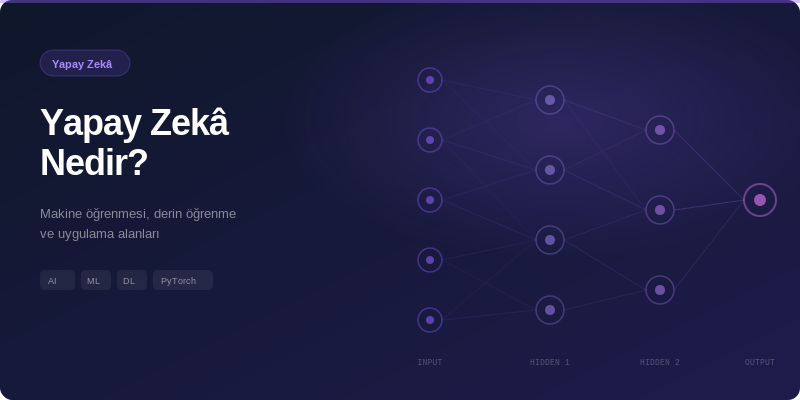
Deep learning, which uses artificial neural networks, is the most powerful subfield of machine learning. It is used in complex tasks such as image recognition, natural language processing and autonomous vehicles.
# A simple neural network example (PyTorch)
import torch
import torch.nn as nn

class SimpleNN(nn.Module):
    def __init__(self):
        super().__init__()
        self.layers = nn.Sequential(
            nn.Linear(784, 128),
            nn.ReLU(),
            nn.Linear(128, 64),
            nn.ReLU(),
            nn.Linear(64, 10)
        )

    def forward(self, x):
        return self.layers(x)
Artificial Intelligence in Everyday Life
- Healthcare: Disease diagnosis, drug discovery, medical imaging
- Finance: Fraud detection, algorithmic trading, credit scoring
- E-commerce: Personalized recommendations, price optimization
- Transportation: Autonomous vehicles, traffic optimization
- Education: Adaptive learning platforms, automated assessment
The Future of Artificial Intelligence
AI technology is advancing rapidly. Large language models such as GPT, DALL-E and Gemini show just how powerful artificial intelligence can be. In the coming years, AI will continue to transform nearly every sector.
💡 Important: Artificial intelligence is a tool. Its ethical use and responsible development are critical for technology to benefit society.