What Is a Web Service?
A web service is a standard software interface that allows applications developed on different platforms and in different programming languages to communicate with each other over the internet. Thanks to web services, a PHP application can communicate seamlessly with a Java application, or a mobile app with a desktop application.
How Does a Web Service Work?
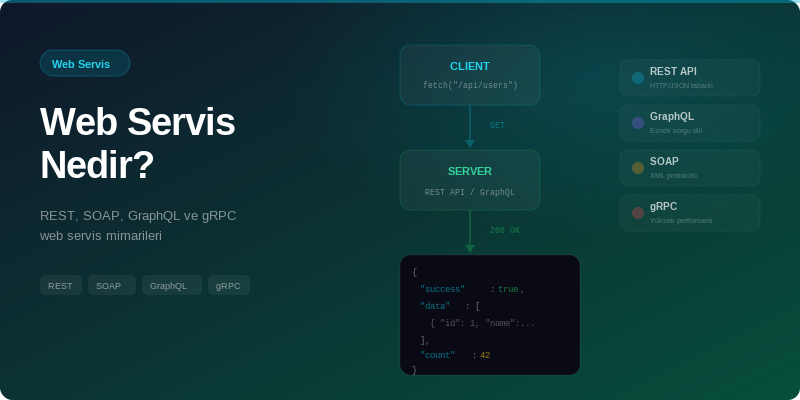
Web services work on the client-server model:
- The Client sends a request
- The Server processes the request and produces a response
- Communication usually takes place over the HTTP/HTTPS protocol
- JSON or XML is used as the data format
Types of Web Services
1. REST (Representational State Transfer)
The most popular web service architecture today. It is a simple, lightweight approach based on HTTP methods (GET, POST, PUT, DELETE).
// REST API Example - Fetching the product list
// GET /api/products
app.get("/api/products", async (req, res) => {
    const products = await Product.find({ active: true });
    res.json({
        success: true,
        data: products,
        count: products.length
    });
});

// Adding a new product
// POST /api/products
app.post("/api/products", async (req, res) => {
    const product = new Product(req.body);
    await product.save();
    res.status(201).json({
        success: true,
        data: product
    });
});
REST API HTTP Methods
| Method | Function | Example |
|---|---|---|
| GET | Read data | GET /api/users/1 |
| POST | Create a new record | POST /api/users |
| PUT | Update a record | PUT /api/users/1 |
| PATCH | Partial update | PATCH /api/users/1 |
| DELETE | Delete a record | DELETE /api/users/1 |
2. SOAP (Simple Object Access Protocol)
An XML-based web service protocol with stricter rules. It is preferred in banking and enterprise systems. It is described using WSDL (Web Services Description Language).
3. GraphQL
A modern query language developed by Facebook. Unlike REST, the client specifies exactly which data it needs and receives only that data.
// GraphQL Query Example
const query = `{
    user(id: 1) {
        name
        email
        orders {
            id
            total
            status
        }
    }
}`;
4. gRPC
A high-performance RPC (Remote Procedure Call) framework developed by Google. It uses the Protocol Buffers format and is much faster than REST. It is widely preferred in microservice architectures.
REST vs SOAP vs GraphQL
| Feature | REST | SOAP | GraphQL |
|---|---|---|---|
| Data Format | JSON, XML | XML only | JSON |
| Ease of Learning | Easy | Hard | Medium |
| Performance | High | Medium | High |
| Flexibility | Medium | Low | Very High |
| Security | HTTPS + JWT | WS-Security | HTTPS + JWT |
| Use Case | General purpose | Enterprise | Modern web/mobile |
Web Service Security
Security is critical for web services:
- HTTPS: All communication should be encrypted
- Authentication: API Key, OAuth 2.0 or JWT should be used
- Rate Limiting: Excessive requests should be blocked
- Input Validation: All incoming data should be validated
- CORS Policies: Requests from unauthorized domains should be blocked
Real-World Examples
Examples of web services in everyday use:
- Weather apps — fetch weather data with the OpenWeatherMap API
- Payment systems — payment APIs such as iyzico and PayTR
- Social media — sharing through the Twitter and Facebook APIs
- Map services — location and directions with the Google Maps API
- E-commerce — product and order management with the Shopify and Trendyol APIs
Conclusion
Web services are one of the cornerstones of modern software development. Choosing the right web service architecture directly affects your application's performance, scalability and maintainability. While REST API remains the most common choice, modern approaches such as GraphQL and gRPC are also being adopted rapidly.