What Is Integration?
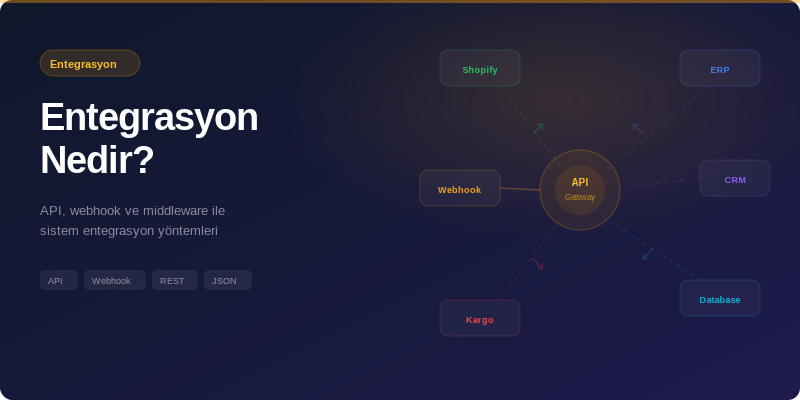
Software integration is the process that enables different software systems, applications and platforms to communicate and share data with each other and work together seamlessly. Today, businesses use dozens of different software products, and it is critical for business processes that these products can talk to each other.
Why Is Integration Needed?
Consider an e-commerce company. It might have the following systems:
- Website (Shopify, WooCommerce)
- Inventory management system (ERP)
- Accounting software
- Shipment tracking system
- CRM (Customer Relationship Management)
- Marketplace accounts (Trendyol, Hepsiburada)
If each of these systems works independently, then when an order arrives, stock has to be updated manually, the invoice has to be issued manually, and the shipment has to be handed to the carrier manually… This leads to both wasted time and errors. Integration automates all of these processes.
Types of Integration
1. API Integration
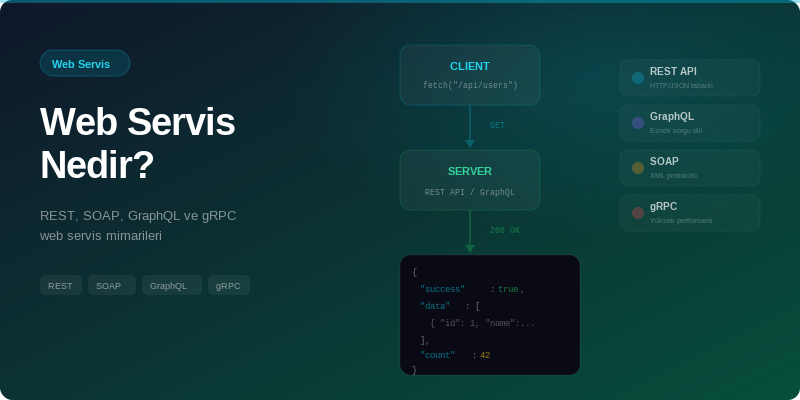
This is the most common integration method. An API (Application Programming Interface) allows two pieces of software to communicate with each other over a standard protocol. REST API and GraphQL are the most popular API architectures today.
// Example: fetching order details with a REST API
const response = await fetch("https://api.example.com/orders/1234", {
    headers: {
        "Authorization": "Bearer API_KEY",
        "Content-Type": "application/json"
    }
});
const order = await response.json();
2. Webhook Integration
The relevant system is automatically notified when an event occurs (order creation, payment confirmation, etc.). Unlike an API, it is event-driven, so there is no need to poll continuously.
3. File-Based Integration
Data is transferred between systems via files in CSV, XML or JSON format. It is frequently used for integration with legacy systems.
4. Database Integration
Different systems share data by accessing the same database. Although fast, it requires care in terms of security and data integrity.
5. Middleware Integration
An intermediate piece of software is used as a bridge between different systems. Apache Kafka, RabbitMQ and MuleSoft are among the tools in this category.
Popular Integration Scenarios
| Scenario | Source | Target | Method |
|---|---|---|---|
| Order synchronization | Shopify | ERP | Webhook + API |
| Stock update | Warehouse system | Marketplaces | REST API |
| Invoice generation | CRM | e-Arşiv | API |
| Shipment tracking | Carrier | Customer portal | Webhook |
| Payment processing | Website | Bank/PayTR | API |
Key Considerations in Integration
- Security: API keys and authentication mechanisms (OAuth 2.0, JWT) should be used
- Error Handling: Retry mechanisms should be built in against connection drops and errors
- Rate Limiting: Exceeding limits in API calls should be avoided
- Data Validation: The format and integrity of transferred data should be checked
- Logging: All integration operations should be recorded
Conclusion
Integration is the key to the efficient operation of modern businesses. With the right integration strategy, business processes become automated, errors decrease and teams become more productive. Whether it is a small e-commerce site or a large enterprise — integration is no longer a choice, it is a necessity.