
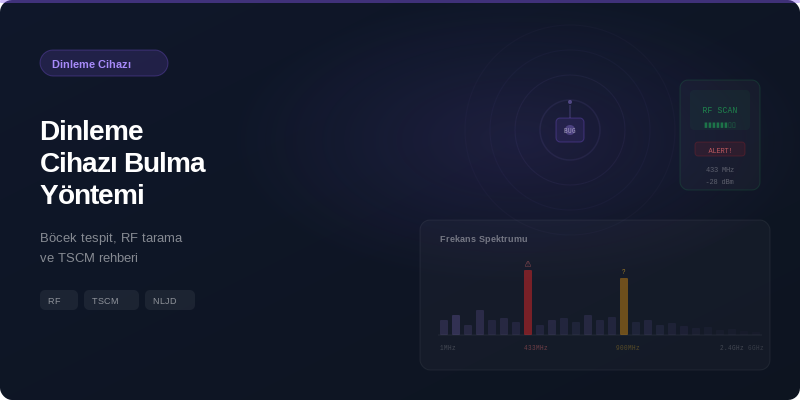
What Are Listening Devices (Bugs)?
Listening devices are micro electronic devices that secretly record conversations in an environment or transmit them live to another location. They are also commonly known as \"bugs\". They can be used for corporate espionage, personal tracking or intelligence purposes.
Types of Listening Devices
| Type | Operating Principle | Range | Detection Method |
|---|---|---|---|
| RF Bug | Live transmission via radio frequency | 50-500m | RF sweep |
| GSM Bug | Uses a SIM card, over a phone line | Unlimited | IMSI catcher / frequency analysis |
| Audio Recorder | Records to internal memory | Local | Physical search / NLJD |
| Laser Microphone | Reads glass vibrations | 100-1000m | Glass vibration jammer |
| Powerline | Signal over the electrical line | Inside the building | Line analysis |
Detection Methods
1. RF (Radio Frequency) Sweep
This is the most common and effective method. Professional RF detectors scan frequencies from 1 MHz to 12 GHz.
- Turn off all electronic devices (including Wi-Fi and Bluetooth)
- Calibrate the RF detector in an open area
- Sweep the room systematically — start from the corners
- When an anomaly is detected, move closer to narrow down the source
2. NLJD (Non-Linear Junction Detector)
An advanced device that can detect even electronic circuits that are switched off:
- It sends a microwave signal to detect the presence of semiconductor components
- It works even when the device is turned off
- It finds devices hidden inside walls, furniture and floors
- False positives can occur (metal objects such as screws and coins)
3. Spectrum Analysis
Frekans Aralığı          Olası Cihaz
─────────────────────────────────────
88-108 MHz               FM verici böcek
315-433 MHz              Basit RF böcek
800-900 MHz              GSM böcek (2G)
1.8-2.1 GHz              GSM böcek (3G/4G)
2.4 GHz                  Wi-Fi bazlı cihaz
5.8 GHz                  İleri Wi-Fi cihaz
4. Physical Inspection
- Check inside outlets, switches and lamps
- Inspect under and behind furniture
- Check ceiling panels and ventilation openings
- Follow the phone and electrical lines
- Watch for unfamiliar new objects
5. Phone Line Check
Landline phones are common targets for eavesdropping:
- Clicking or echo heard when picking up or hanging up
- Line voltage lower than normal
- A faint buzzing in the background during calls
The Professional TSCM Process
TSCM (Technical Surveillance Counter Measures) is the professional process of detecting and removing listening devices:
- Preliminary assessment and risk analysis
- RF spectrum sweep
- NLJD sweep
- Phone line analysis
- Physical search
- Report and security recommendations
💡 Tip: If you have serious security concerns, consider using a professional TSCM service. Amateur equipment may fail to detect some advanced devices.